

MatSimKit-Flow
Material Workflow Integration Software
"Make material data access as simple as calling an API"
Wraps professional material calculation engines as standard HTTP services, so industrial simulation software obtains complete thermophysical datasets from liquidus to room temperature with a single API call.
Product Overview
Automated Material Thermophysical Data Service
Once simulation software submits alloy composition information, MatSimKit-Flow automatically calls the JMatPro® engine, completes the calculation, and returns structured result data to the caller. All outputs are automatically converted to SI units and can be imported directly into simulation software, eliminating manual data lookup and assembly entirely. The service supports thermodynamic calculations, thermophysical property calculations, solidification calculations, mechanical property calculations, kinetic phase transformation calculations, and more — flexibly configurable to deliver exactly the data each simulation software needs.
The system also supports a composition-range batch calculation mode: users specify an element's content range and step size, and the system automatically expands to multiple composition points for batch calculation — one submission yields complete datasets across different composition ratios, greatly improving data acquisition efficiency during material R&D and process optimization.
Unified Multi-Software Integration Management
MatSimKit-Flow adopts a unified-platform, differentiated-service architecture. Multiple simulation software clients connect to a single service instance simultaneously, each with its own identity, access permissions, and calculation strategy configuration. The system delivers material data tailored to each client's requirements, enabling a single service deployment to simultaneously support casting, heat treatment, forming, and other process simulation workflows.
Integration is built on the standard HTTP REST protocol, with clear documentation and minimal onboarding effort. Regardless of the programming language or platform a simulation software uses, connection can typically be completed with just a few lines of code, requiring no specialist integration work.

Visual Management Console and Secure Operations
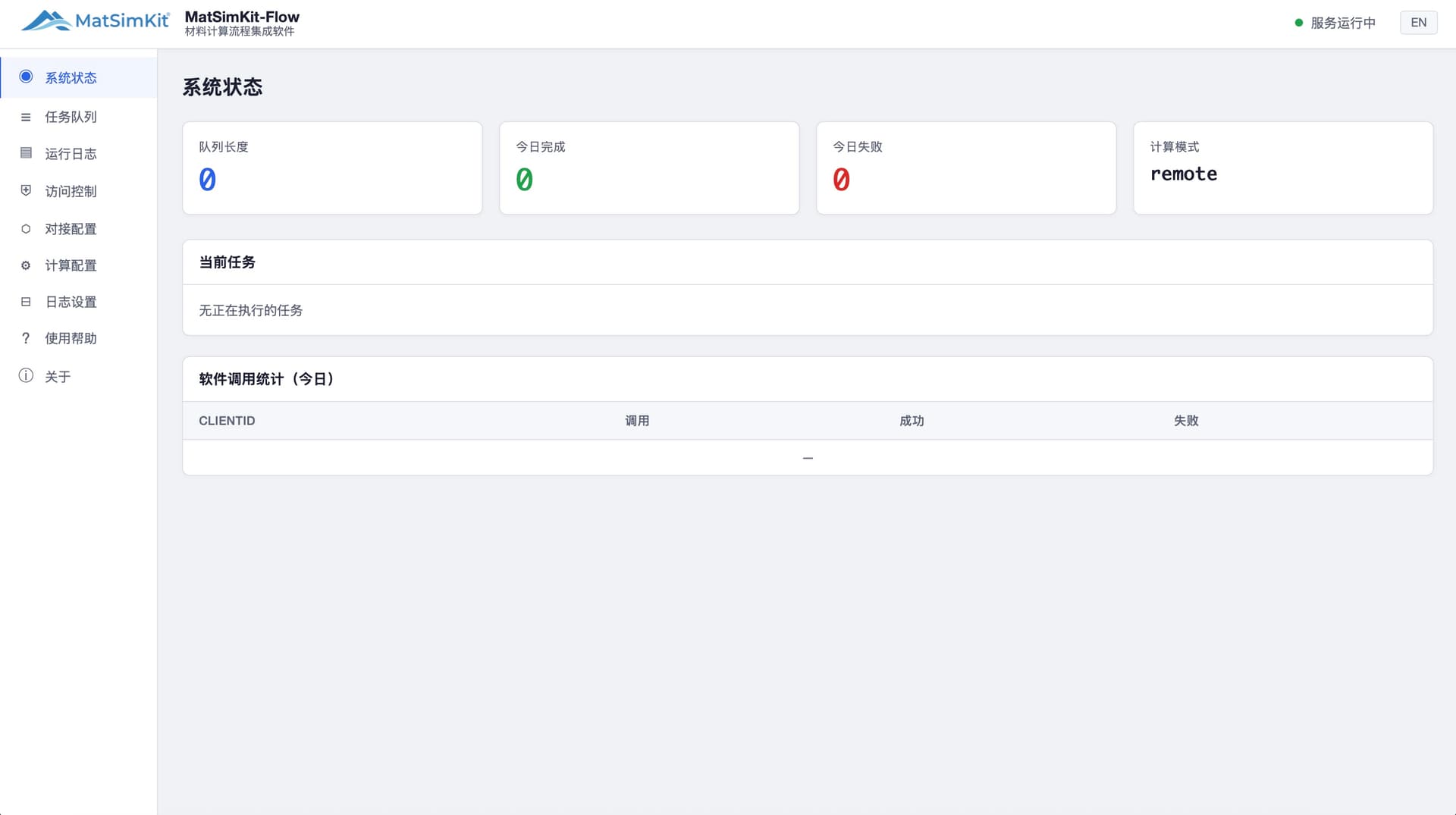
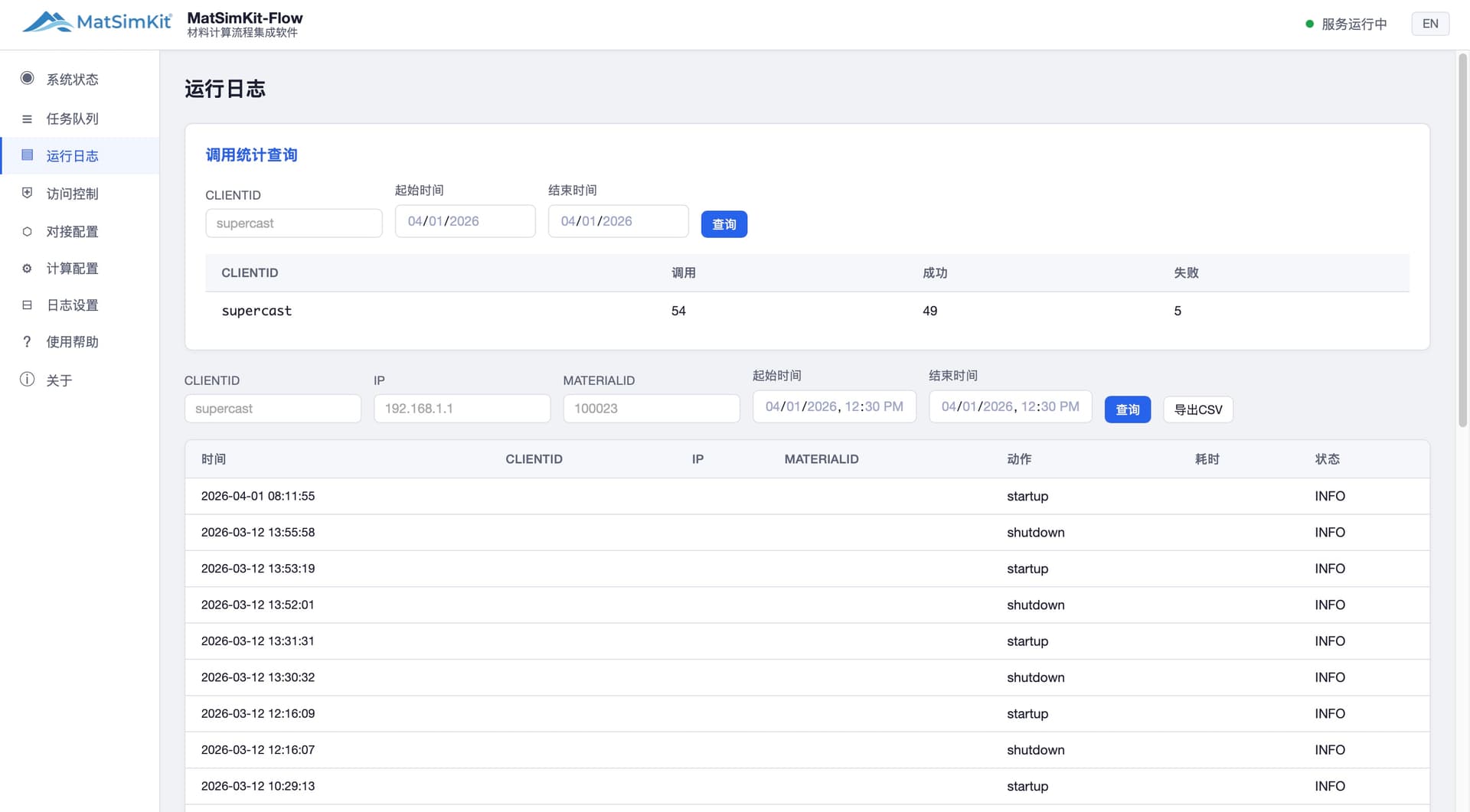
The built-in professional web management console provides comprehensive operations capabilities: real-time calculation queue monitoring, runtime log queries, client access permission management, and IP whitelist configuration — all in a bilingual (Chinese/English) interface. Configuration changes take effect immediately without a service restart, ensuring 24/7 continuous operation.
The system incorporates multi-layer security: IP whitelisting and call-rate limiting prevent unauthorized access; structured logging ensures every API call is fully traceable; automatic timeout protection and exception callback retry mechanisms guarantee service stability and reliability. The main service can be deployed on Windows, Linux, or macOS, and also supports a cloud main-service plus local compute-node split-deployment architecture that fully protects existing JMatPro® license investments.
Product Highlights
One API Call, Complete Material Data
Simulation software needs no knowledge of material calculation complexity — a single API call returns all required material property data, eliminating manual data lookup and assembly entirely.
One Service, Multiple Software Clients in Parallel
A single service instance serves multiple simulation software clients simultaneously, each independently configured — casting, heat treatment, and forming workflows all share one material calculation backbone, reducing redundant infrastructure.
Standard Interface, Fast and Low-Cost Integration
Built on the HTTP REST standard with no language or platform restrictions; integration typically requires just a few lines of code, dramatically lowering the barrier for simulation software to access professional material calculations.
Enterprise-Grade Reliability, 24/7 Uptime
Multi-layer security, structured logging, and automatic fault-tolerance mechanisms — combined with hot-reload configuration that requires no service restart — ensure continuous stable operation in production environments.
Application Scenarios

Casting Simulation
Provide solidification process data for SuperCAST, ProCAST, MAGMA, and other software, supporting filling, solidification, and shrinkage porosity simulations.

Heat Treatment Simulation
Provide thermal conductivity, specific heat, phase transformation temperature, and modulus data for viHeat and similar software supporting quenching, tempering, and normalizing.

Forming Simulation
Provide flow stress and thermophysical parameters for DEFORM, Simdroid, and similar software supporting forging, rolling, and drawing simulations.

Material R&D & Process Optimization
Composition range calculation feature batch-obtains material property data across different composition ratios to support alloy design and process parameter research.
Technical Specifications
| Main Service Platform | Windows / Linux / macOS |
| Version | V2.0.0 |
| Interface Type | Standard HTTP REST API |
| Calculation Engine | JMatPro® API (compute node) |
| Alloy Systems | Fe, Co, Ni, Al, Mg, Ti, Cu, Zr, Sn alloys |
| Deployment | Single machine / Cloud main + local compute node |